
25 Years Later, These Are the 10 Best Movies of 2001
Although it was one year into the new millennium, 2001 technically marked the beginning of the 21st century. Proving how quickly time passes by, the year that signaled the dawn of a new era for humanity, culture, and technology is now 25 years old. While the year has obviously been memorialized by the September 11th attacks, 2001, in retrospect, it turned out to be an inflection point in pop culture, and its aftershocks still linger in cinema today. Fittingly enough, the year that shares the name with Stanley Kubrick’s sci-fi masterpiece about the evolution of life saw totemic releases like the debut of Harry Potter and The Lord of the Rings, franchises that showed Hollywood a new pathway to the future of moviegoing. From major blockbusters to acclaimed arthouse auteurist visions, narrowing down the 10 best movies of 2001 was a cumbersome task.
10
‘Moulin Rouge!’
Ewan McGregor as Christian and Nicole Kidman as Satine in a loving embrace in a still from ‘Moulin Rouge!’Image via 20th Century Studios
Movie musicals were never the same after Moulin Rouge! swung into theaters in the summer of 2001. Baz Luhrmann, the master of visual and auditory glamor, revamped the genre with his rapid-fire editing, hypnotic visual language, electric pacing, and use of anachronistic pop music to round out this jukebox musical. Starring Nicole Kidman and Ewan McGregor as star-crossed lovers whose romance becomes a Shakespearean tragedy, Moulin Rouge! earns its exclamation point in its title. “Loud” doesn’t even come close to describing the vigor and relentless enthusiasm of Luhrmann’s signature movie. Right when you get on the film’s bonkers wavelength and catch up with its intense camera movements and breathless editing, Luhrmann undercuts the sensationalism with a tender, affectionate, yet poignant romance between wistful poet Christian (McGregor) and aspiring actress Satine (Kidman). Just as indelible as the sets are the catchy songs, which sample the best pop music and musical numbers of the 20th century. Although Moulin Rouge!’s story is predictable, if not maudlin, it hits all the right spots. Luhrmann kicked off the right kind of boisterous party to start the century.
9
‘Ghost World’
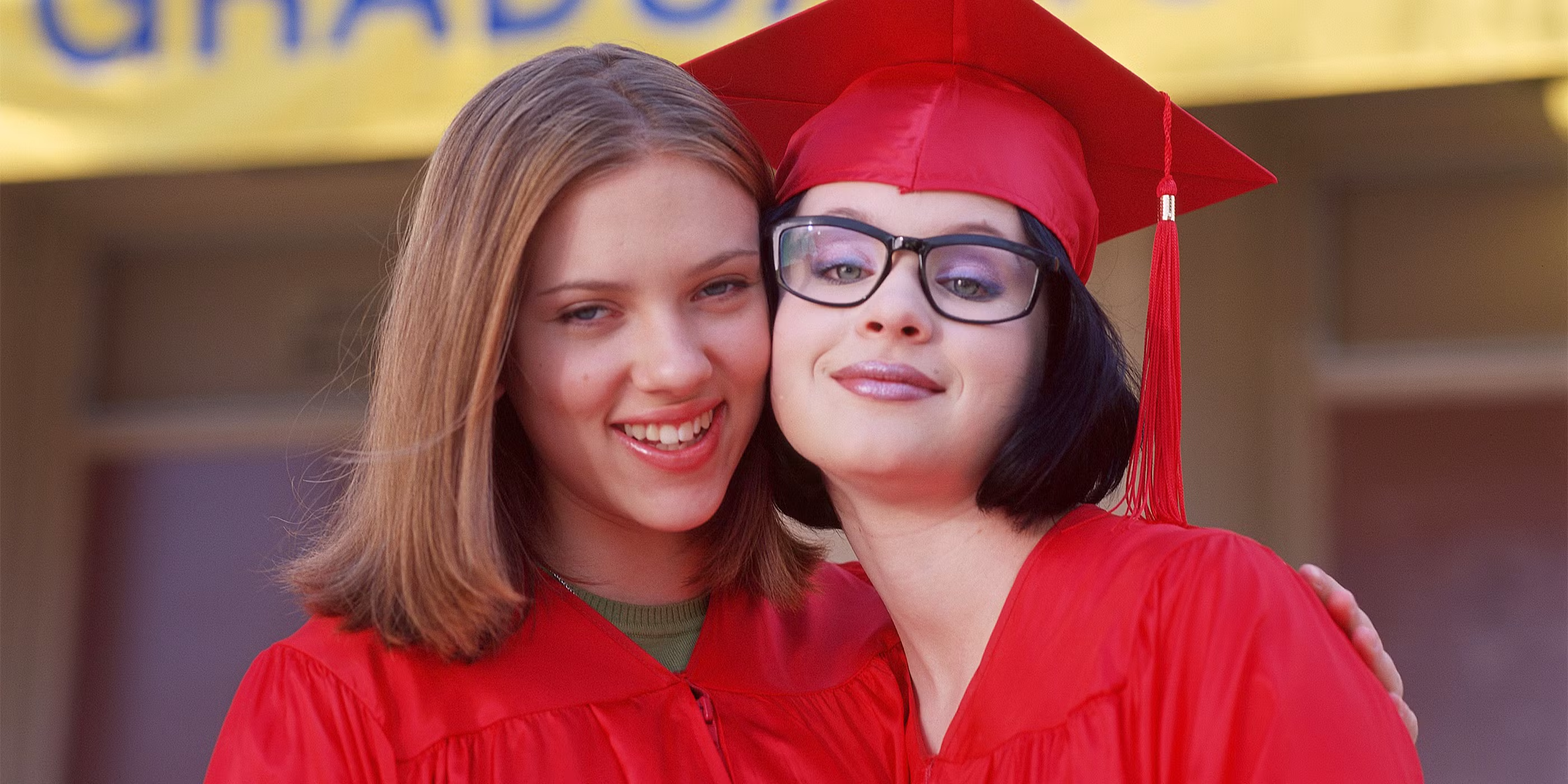
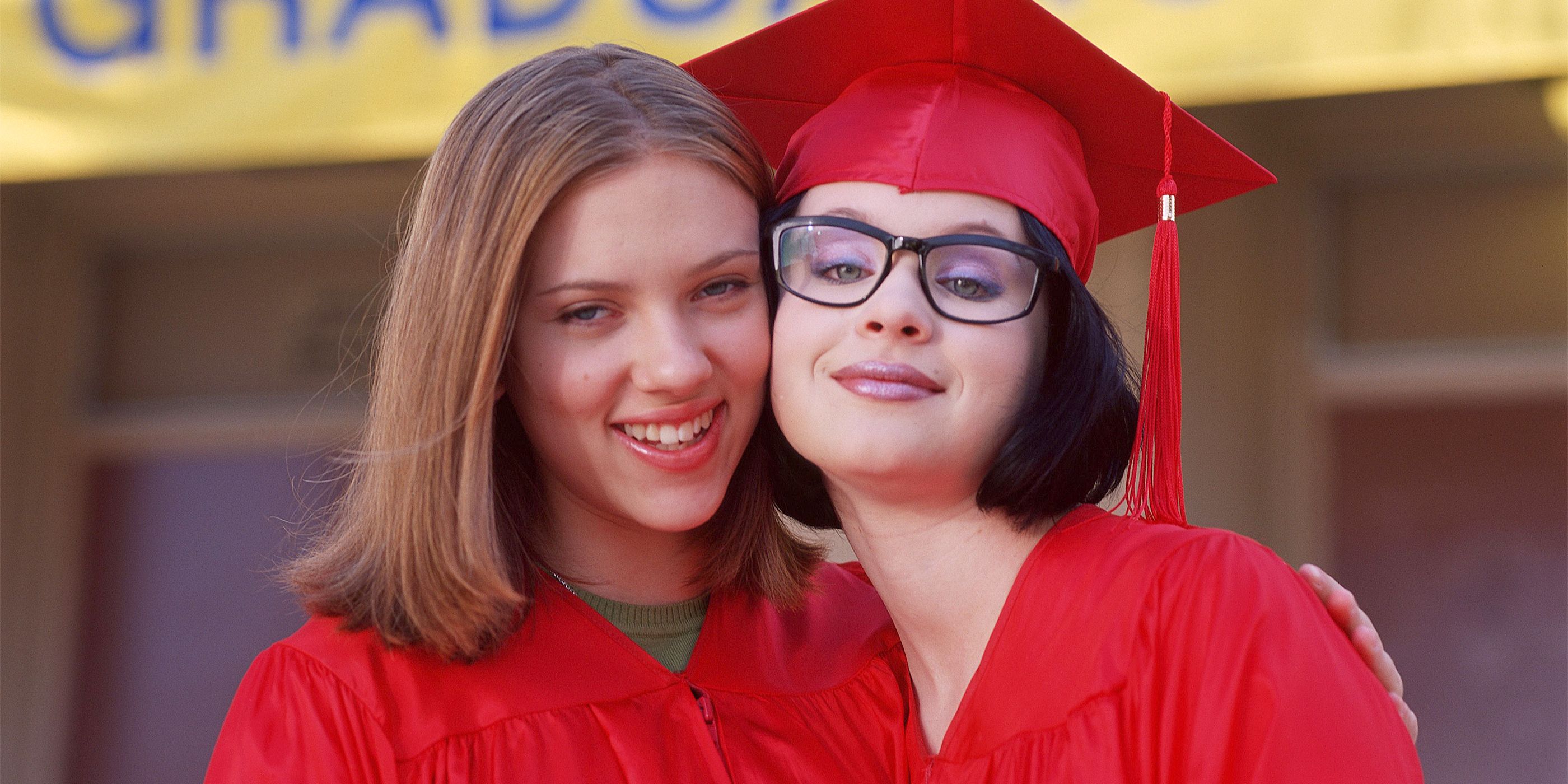
Thora Birch and Scarlett Johansson standing next to a bush in Ghost WorldImage via MGM
This is no superhero movie. In what comic book or graphic novel could you ever find a story about two disaffected teen girls navigating through a cruel and confusing world? That’s what makes Ghost World, the Daniel Clowes graphic novel and the Terry Zwigoff screen adaptation, so special. After honoring the work of iconoclastic comic book artist Robert Crumb, Zwigoff directed a signature film for everyone who’s ever been misunderstood. Ghost World, led by Scarlett Johansson and Thora Birch, and featuring a stand-out supporting performance by Steve Buscemi, reflects an era where comics were underground and fashionable among arthouse corners before they became billion-dollar enterprises for movie studios. Zwigoff’s pitch-black and countercultural sensibilities that drove Crumb and Bad Santa are at their peak in his 2001 indie that earned a Best Adapted Screenplay nomination. Ghost World is effortlessly hilarious, even when it seems like Zwigoff has such scorn for his own quirky characters and their world that’s alien to them. While it’s initially coated in irony, the movie embraces the emotionality of Rebecca (Johansson) and Enid (Birch). Despite their glib attitude, these outsiders just want to feel loved and understood in a thankless world.
8
‘Ocean’s Eleven’
George Clooney and Brad Pitt in Ocean’s ElevenImage via Warner Bros. Pictures
In what is perhaps the slickest and effortlessly cool Hollywood movie made in the last 25 years, Ocean’s Eleven is the best piece of evidence that filmmakers should remake unsuccessful movies with a strong premise. The original 1960 heist movie starring members of the Rat Pack was strangely dull and meandering, but if you find a sharp director like Steven Soderbergh and the present-day batch of the most suave stars, the movie ostensibly writes itself. Sure enough, 2001’s Ocean Eleven paid out like a slot machine. This murderer’s row of seismic movie stars, which includes George Clooney, Brad Pitt, Julia Roberts, and Matt Damon, tells you everything you need to know about Ocean’s Eleven. The film carries itself with a swagger and flair that can only manifest with this level of Hollywood pedigree. Not to mention, Soderbergh’s fast-paced and precise direction keeps the flow electric. The director knows when to expedite the plot and let the scene play out methodically so that his charismatic stars can banter. Ocean’s Eleven perfectly calibrated the stardom of Clooney and Pitt, and their respective careers are indebted to Soderbergh’s blueprint. A lively piece of pop entertainment crafted with the excellence of prestige fare, the film is exactly the kind of cinematic bravura that appeals to four quadrants.
7
‘The Piano Teacher’
Erika looking at Walter as he plays the piano in The Piano TeacherImage via Kino International
You have to be in the right mood to sit down and let the psychological dread and unsettling vibes of Michael Haneke’s movies enter your world. The world-renowned Austrian filmmaker of dark, often bleak dramas rattles everyone to the bone, and his films leave an indelible imprint. Before delving into the dread and nihilism portrayed in Funny Games or Caché, a strong gateway film to Haneke’s world is The Piano Teacher, arguably his most striking and formally impressive effort to date. Starring Isabelle Huppert as Erika Kohut, a repressed music instructor who enters a thorny relationship with her student, Walter Klemmer (Benoît Magimel), The Piano Teacher chronicles the generational domino effect of trauma and domineering partnerships, as Erika’s mother (Annie Girardot) controls every ounce of her being, causing the icy teacher to turn to masochistic proclivities. Huppert gives one of the signature performances of the decade, seamlessly walking the tightrope between absurdist black comedy and gut-wrenching anguish throughout the film. Haneke lets the innate character drama and uncanny quirks of human relations carry the momentum, making The Piano Teacher a surprisingly captivating watch, despite its emotionally burdensome ideas. As perverse as the movie is, you’ll never want to look away.
6
‘Memento’
Leonard Shelby, played by actor Guy Pearce, sits starkly shadowed in crisp black and white in Memento.Image via Newmarket Films
After watching Memento, no one will need tattoos or Polaroids to remember what they just witnessed. Before becoming the face of blockbuster cinema with The Dark Knight and The Odyssey, Christopher Nolan was the most exciting voice in the mystery/neo-noir genre. Thanks to his slick style and inventive manipulation of narrative chronology, Nolan was destined to have a modern noir classic in his repertoire. Even after all these years, Memento, which tracks the director at his darkest and most haunted, remains one of Nolan’s crowning achievements. Memento taught audiences to never expect a conventional story structure in a Nolan film. With his second feature, the Oppenheimer director crafted a labyrinthian mystery crime thriller about Leonard Shelby (Guy Pearce), who tracks down his wife’s murderer under harsh circumstances, as he suffers from short-term memory loss. Nolan makes the bold decision to drop the audience into Leonard’s mindset, and it’s up to you to put the pieces together by connecting a linear timeline with a reverse linear timeline. Filled with gripping procedural and action set pieces, a rich character study about manipulation and alternate realities, and even dashes of refreshing levity, Memento makes you wish that Nolan would return to stripped-down, mid-budget crime movies in between his galactical epics. In the century’s inaugural year, the industry found its next great auteur.
5
‘Y tu mamá también’
Y tu mamá también (2001) characters dancingImage via 20th Century Studios
Audiences have never seen a love triangle movie like Y tu mamá también before or since its release. For cinephiles, this Mexican coming-of-age road-trip dramedy was the thing to seek out, although its shotgun blast of laughs, lurid images, and fiery character dynamics make it accessible to all viewers. More than anything, the film announced the presence of a genuine auteur in Alfonso Cuarón, who would go on to direct major blockbusters like Gravity and even a Harry Potter movie. Y tu mamá también is an erotically charged, provocative study of age, masculinity, and repressed sexuality that lures you in with its compelling setup and promise for explicit material, but in the end, it confronts your psychology and overall comfort. The chemistry between its stars, Maribel Verdú as Luisa and Gael Garcia Bernal and Diego Luna as Julio and Tenoch, respectively, crackles with fluid romanticism and thick tension. Cuarón’s gifts as a visual storyteller shine in this film that doesn’t necessarily demand flashy filmmaking, but it’s grandeur and documentary-like grit make this archetypal story unforgettable. A poignant reflection of coming-of-age and aimlessness as an adult, Y tu mamá también is a multi-layered odyssey of licentiousness, pent-up rage, and alienation.
4
‘The Royal Tenenbaums’
To this day, Wes Anderson continues to push his idiosyncratic vision to new territories. While he’s gotten more formally ambitious and thematically dark in recent years, Anderson has still yet to recapture the level of heart and rich characterization of The Royal Tenenbaums, his third feature that made it crystal clear that he was no flash in the pan. Paired up with a Hollywood legend, Gene Hackman, and his usual robust ensemble cast, this family dramedy proved that the writer-director has always been a humanist beneath his opulent set design. What separates The Royal Tenenbaums from the Anderson pack is its titanic, career capstone performance by the late Gene Hackman, a no-nonsense, old-school dramatic heavyweight and the perfect counter to the director’s hyper-detailed, painterly visual language. Hackman upends his familiar steely edge for a riveting performance that sees him playing a quintessential bad dad trying to open the emotional pathways he locked away from his dysfunctional kids. Along with remarkable performances by Gwyneth Paltrow, Luke Wilson, and Ben Stiller, The Royal Tenenbaums is Anderson’s most subtle effort behind the camera, but his unique eye for New York City interiors remains splendid, and his affinity for serio-comic story and character beats is evidence of his preternatural talents.
3
‘A.I. Artificial Intelligence’
David (Haley Joel Osment) looks at the A.I. being in ‘A.I. Artificial Intelligence’Image via Warner Bros. Pictures
Unfairly maligned by many and egregiously misunderstood upon release, true fans of Steven Spielberg know that A.I. Artificial Intelligence is a landmark achievement for not just the legendary director but also the entire medium itself. Burdened with the high expectation of being Stanley Kubrick’s unrealized passion project, Spielberg honored the late director’s cold dissection of humanity with his own pop and adventurous sensibilities to create something magical, haunting, and a sobering cautionary tale about advanced technology.
A film that grows in importance each passing day, A.I. underlined the dark side of Spielberg’s glossy and hopeful vision of the world.
First things first when discussing A.I. is to address the elephant in the room: its ending, erroneously read as a cop-out, Spielbergian happy ending, is anything but optimistic. The film’s heart-wrenching final moments tie together Spielberg and Kubrick’s themes surrounding the perils of humanizing artificial intelligence. In the end, it’s an inhuman life form that cannot replace love, family, and personal growth. A film that grows in importance each passing day, A.I. underlined the dark side of Spielberg’s glossy and hopeful vision of the world. The state-of-the-art android, David (Haley Joel Osment), can be programmed to love and serve as an adopted child, but this artifice ultimately destroys our entire notion of true love. Featuring arguably the finest child performance in history by Osment, A.I. is an expansive odyssey that depicts the world at its most vulnerable and susceptible to technological takeover.
Collider Exclusive · Oscar Best Picture Quiz
Which Oscar Best PictureIs Your Perfect Movie?
Parasite · Everything Everywhere · Oppenheimer · Birdman · No Country
Five Oscar Best Picture winners. Five completely different visions of what cinema can be — and what it can do to you. One of them is the film that was made for the way your mind works. Ten questions will figure out which one.
Parasite
Everything Everywhere
Oppenheimer
Birdman
No Country for Old Men
FIND YOUR FILM →
01
What kind of film experience do you actually want?
The best movies don’t just entertain — they leave something behind.
ASomething that pulls the rug out — that makes me think I’m watching one kind of film and then reveals I’m watching another entirely.
BSomething overwhelming — funny, sad, absurd, and genuinely moving, all at once.
CSomething grand and weighty — a film that makes me feel the full scale of what I’m watching.
DSomething formally daring — a film that pushes what cinema can even do.
ESomething lean and relentless — pure tension with no wasted frame.
NEXT QUESTION →
02
Which idea grabs you most in a film?
Great films are driven by a central obsession. What’s yours?
AClass, inequality, and what people are willing to do when desperation meets opportunity.
BIdentity, family, and the chaos of trying to hold your life together when everything is falling apart.
CGenius, moral responsibility, and the catastrophic weight of a decision you can never take back.
DEgo, legacy, and the terror of becoming irrelevant while you’re still alive to watch it happen.
EEvil, chance, and whether moral order actually exists or if we just tell ourselves it does.
NEXT QUESTION →
03
How do you like your story told?
Form is content. The way a story is shaped changes what it means.
AGenre-twisting — I want it to start in one lane and migrate into something completely different.
BMaximalist and genre-blending — comedy, action, drama, sci-fi, all in one ride.
CEpic and non-linear — cutting between timelines, building a mosaic of cause and consequence.
DA single unbroken flow — I want to feel like I’m living it in real time, no cuts to safety.
ESpare and precise — every scene doing exactly what it needs to do and nothing more.
NEXT QUESTION →
04
What makes a truly great antagonist?
The opposition defines the protagonist. What kind of opposition fascinates you?
AA system — invisible, structural, and almost impossible to fight because it has no single face.
BThe self — the ways we sabotage, abandon, and fail the people we love most.
CHistory — the unstoppable momentum of events that no single person can stop or redirect.
DThe industry — the machinery of culture that chews up talent and spits out irrelevance.
EPure, implacable evil — a force so certain of itself it becomes almost philosophical.
NEXT QUESTION →
05
What do you want from a film’s ending?
The final note is the one that lingers. What do you want it to sound like?
AShock and inevitability — a conclusion that recontextualises everything that came before it.
BEarned emotion — I want to cry, laugh, and feel genuinely hopeful, even if the world is a mess.
CDevastation and grandeur — an ending that makes me sit in silence for a few minutes after.
DAmbiguity — something that leaves enough open that I’m still thinking about it days later.
EBleakness — an honest refusal to pretend the world is tidier than it actually is.
NEXT QUESTION →
06
Which setting pulls you in most?
Where a film takes place shapes everything — mood, stakes, what’s even possible.
AA gleaming modern city with a hidden underside — beauty masking rot, wealth masking desperation.
BA collapsing suburban life that opens onto something infinite — the multiverse of a single ordinary person.
CThe corridors of power and science at a world-historical turning point — where decisions echo for decades.
DThe grimy, alive chaos of New York and Hollywood — fame as both destination and trap.
EVast, indifferent landscape — desert and highway where violence arrives without warning or reason.
NEXT QUESTION →
07
What cinematic craft impresses you most?
Every great film has a signature — a technical or artistic element that makes it unmistakable.
AProduction design and mise-en-scène — every frame composed to carry meaning beneath the surface.
BEditing and tonal control — the ability to move between registers without losing the audience.
CScore and sound design — music that becomes inseparable from the dread and awe of what you’re watching.
DCinematography as performance — the camera not recording events but participating in them.
ESilence and restraint — what’s left unsaid and unshown doing more work than any dialogue could.
NEXT QUESTION →
08
What kind of main character do you root for?
The protagonist is the lens. Who you choose to follow says something about you.
ASomeone smart and resourceful who makes increasingly dangerous decisions under pressure.
BSomeone overwhelmed and ordinary who turns out to be capable of something extraordinary.
CA brilliant, tortured figure whose gifts and flaws are inseparable from each other.
DA self-destructive artist whose ego is both their superpower and their undoing.
EA quiet, principled person trying to make sense of a world that has stopped making sense.
NEXT QUESTION →
09
How do you feel about a film that takes its time?
Pace is a choice. Some films sprint; others let tension accumulate slowly, deliberately.
AI love a slow build when I know the payoff is going to be seismic — patience for a devastating reveal.
BGive me relentless momentum — I want to feel breathless and emotionally spent by the end.
CEpic runtime doesn’t scare me — if the material demands three hours, give me three hours.
DI want it to feel propulsive even when nothing is technically happening — restless energy throughout.
EDeliberate and unhurried — I want dread to accumulate in the spaces between the action.
NEXT QUESTION →
10
What do you want to feel walking out of the cinema?
The best films leave a mark. What kind of mark do you want?
AUnsettled — like I’ve just seen something I can’t fully explain but can’t stop thinking about.
BMoved and energised — like the film reminded me what actually matters and gave me something to hold onto.
CHumbled — like I’ve been in the presence of something genuinely important and overwhelming.
DExhilarated — like I’ve just seen cinema doing something it’s never quite done before.
EHaunted — like a cold, quiet dread that stays with me for days.
REVEAL MY FILM →
The Academy Has Decided
Your Perfect Film Is…
Your answers have pointed to one Oscar Best Picture winner above all others. This is the film that was made for the way your mind works.
Parasite
You are drawn to films that operate on multiple levels simultaneously — that begin in one genre and quietly, brilliantly migrate into another. Bong Joon-ho’s Parasite is a film about class, desire, and the architecture of inequality that manages to be darkly funny, deeply suspenseful, and genuinely shocking across a single extraordinary running time. Your instinct is for cinema that hides its true intentions until the moment it’s ready to reveal them. Parasite is exactly that — a film that rewards close attention and punishes assumptions, right up to its devastating final image.
Everything Everywhere All at Once
You want it all — and this film gives you all of it. The Daniels’ Everything Everywhere All at Once is one of the most maximalist films ever made: action comedy, multiverse sci-fi, family drama, existential crisis, and a genuinely earned emotional core that sneaks up on you amid the chaos. You are someone who responds to ambition, who doesn’t want cinema to choose between being entertaining and being meaningful. This film refuses that choice entirely. It is overwhelming by design, and its overwhelming nature is precisely the point — because the feeling of being crushed by infinite possibility is exactly what it’s about.
Oppenheimer
You are drawn to cinema on a grand scale — films that understand history not as a backdrop but as a force, and that place their characters inside that force and watch what happens. Christopher Nolan’s Oppenheimer is a film about the terrifying gap between what we can do and what we should do, told with the full weight of one of the most consequential moments in human history behind it. You want your films to feel important without feeling self-important — to earn their ambition through sheer craft and the gravity of their subject. Oppenheimer does exactly that. It is enormous, complicated, and refuses easy comfort.
Birdman
You are drawn to films that foreground their own construction — that make the how of the filmmaking part of the what it’s about. Alejandro González Iñárritu’s Birdman, shot to appear as a single continuous take, is cinema examining itself through the cracked mirror of a fading actor’s ego. You respond to formal daring, to the feeling that a film is doing something that probably shouldn’t be possible. Michael Keaton’s performance and Emmanuel Lubezki’s restless camera create something genuinely unlike anything else — a film that is simultaneously about creativity, relevance, self-destruction, and the impossibility of ever truly knowing if your work means anything at all.
No Country for Old Men
You are drawn to cinema that trusts silence, that refuses to explain itself, and that treats dread as a form of meaning. The Coen Brothers’ No Country for Old Men is a film about the arrival of a new kind of evil — implacable, arbitrary, and utterly indifferent to the moral frameworks we use to make sense of the world. It is one of the most formally controlled films ever made, and its controlled restraint is what makes it so terrifying. You want your films to haunt you, not comfort you. You are not interested in resolution if resolution would be dishonest. No Country for Old Men is honest in a way that most cinema never dares to be.
↻ RETAKE THE QUIZ
2
‘The Lord of the Rings: The Fellowship of the Ring’
Frodo on the floor about to put on the One Ring in The Lord of the Rings: The Fellowship of the RingImage via New Line Cinema
One of the boldest gambles in cinematic history, New Line Cinema granted a relatively unknown filmmaker, Peter Jackson, carte blanche to faithfully adapt J.R.R. Tolkien’s Lord of the Rings book trilogy with the scope of a classic Hollywood epic. On top of it all, he would be shooting all three movies concurrently. Because The Lord of the Rings: The Fellowship of the Ring, as well as its two successors, is so revered, it’s easy to overlook how miraculous the first movie’s triumph was, as it paved the way for the future of blockbuster cinema.
Although The Two Towers and Return of the King raise the stakes and capitalize on the world-building of their predecessor to epic proportions, Fellowship of the Ring remains the series’ apex. Jackson pulls an incredible trick by making the film feel complete and wholly satisfying while also making you excited to continue how this saga manifests on Middle-earth. While lighter on action than its sequels, Fellowship’s hero arcs, mythmaking, and iconic lines represent the peak of cinematic euphoria. The key to the viability of Lord of the Rings as a franchise was its cast, which Jackson nailed, and minted Elijah Wood, Viggo Mortensen, and Orlando Bloom into stars. Fellowship of the Ring signaled that the tides were turning in Hollywood, and audiences began demanding that all adaptations of beloved texts have this level of craft and integrity.
1
‘Mulholland Drive’
Naomi Watts and Laura Harring looking upward in Mulholland Drive.Image via Universal Pictures
Having been anointed as one of the finest achievements in cinematic history by the 2022 Sight and Sound poll, Mulholland Drive’s sheer existence is a miracle, let alone standing as a triumphant masterpiece. Initially conceived as a television series by David Lynch, this failed pilot was adapted into a feature film before becoming the late director’s most uncompromising and masterful work of art. With its alluring ambiguity, deconstruction of fame, and haunting portrait of the dreamscape, the film will endure for the rest of time. By 2001, one would think that the medium couldn’t be evolved any further, but Lynch quietly proved everyone wrong with Mulholland Drive, which channels his earlier work in film and television while pushing the envelope to new, profound heights. While Lynch’s exploration of the subconscious and the disillusionment of an aspiring actor, Betty (Naomi Watts), aimed towards more abstract ideas, the film manages to be shockingly accessible and open to surface-level entertainment. Rich with immersive photography, unsettling atmospheres, thorny questions about fame and identity, and a sprinkling of amusing exchanges, Mulholland Drive showed that surreal cinema doesn’t have to be an anguishing exercise for casual audiences. It’s compulsory viewing for everyone to understand the mythical potential of the art form. Lynch’s ability to speak to the viewers’ hearts and probe their psyche will remain unmatched.
Release Date
October 19, 2001
Runtime
147 minutes
Director
David Lynch
Writers
David Lynch
تم النشر: 2026-06-16 00:08:00
مصدر: collider.com