
Gary Shteyngart, a Russian-Born Author, Tours Thomas Jefferson’s Home With His Son
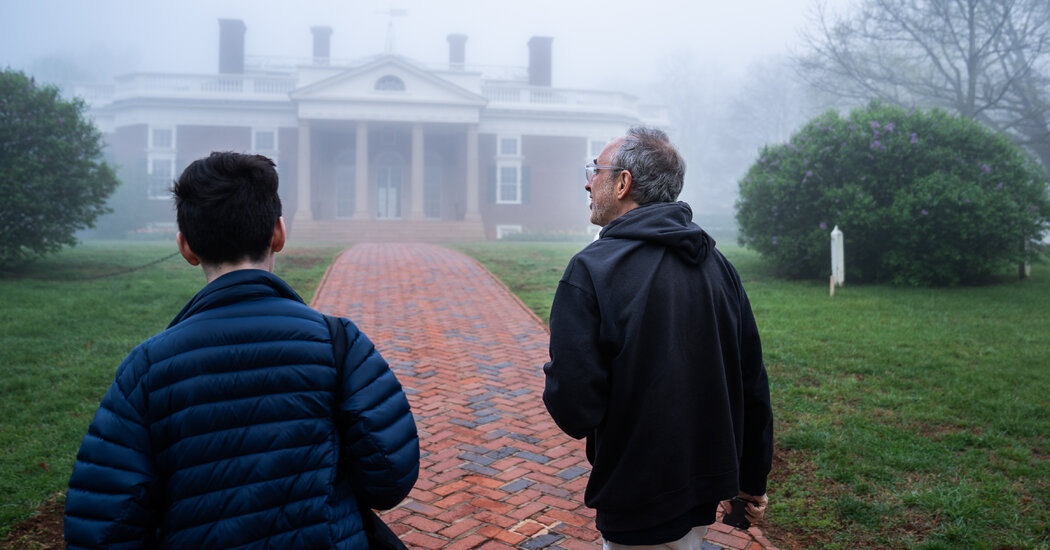
This is the seventh article in a series about travel and the 250th anniversary of the Declaration of Independence.Monticello is the key to America and America will break your heart. With every brick, every vegetable plot, every budding tulip, Thomas Jefferson’s estate announces the uniqueness of our civilization, just as it submerges the visitor in the gruesome details of its original sin. The main building greets the early-morning visitor as a domed wonder of French 18th-century design but also as a structure contained and democratized by American modesty — an architectural manifestation of the Enlightenment and the opposite of the pompous and oversize ballroom proposed to replace the ruins of the White House’s East Wing by its current occupant.You behold its simplicity and symmetry as it is bathed in the morning fog, you tour the ingenuity of Jefferson’s many creations and embellishments within, and then a staff member brings you face to face with a detail of the facade’s brickwork, the handprints of a young enslaved child who made those bricks just a few minutes’ stroll down from the mountaintop and an endless march away from the Enlightenment Jefferson held dear.I came to Monticello with my 12-year-old son, Johnny. His father is an immigrant, born in the Soviet Union, and his mother is the daughter of immigrants from Korea. (Is it any wonder we gave Johnny the most American name imaginable?) I remember being presented with his birth certificate and seeing the place of birth listed as “New York” and still wondering, despite my many years in this country, how such a miracle was possible. As the bittersweet 250th anniversary of our country approached, I wanted to take my son, a big fan of social studies and history, to see Monticello. I wanted to contrast what being an American felt like for me as a newcomer in the early 1980s and for him as a native-born kid living through one of modern America’s moments of uncertainty and national angst.Two American ChildhoodsRecently, I stumbled upon a PBS “Frontline” documentary from 1983 titled “The Russians Are Here,” a snapshot of parts of Russian-speaking communities such as the famous one in Brighton Beach, Brooklyn. I grew up in Queens, but the sentiments of the Soviet immigrants in the documentary were exactly the ones I had known as a child.“It’s too much freedom here,” one Russian-accented cabby says to the camera.“So why did you come here?” he is asked.His reply: “I want to be free!”“For Black people is too much freedom,” another cabby says.Freedom, yes, but for whom? Democracy, sure. But, also, for whom? Without being entirely proficient in our country’s history, the Russian-speaking newcomers had articulated America’s eternal paradox, the paradox of Monticello itself.One of my earliest memories from 1980s Queens was a Scholastic book fair at my school. I came away with two children’s books — one about Harriet Tubman and the other about George Washington (like my son, I was interested in the past). At first, I kept reading, or trying to read — my English wasn’t so hot — the Tubman, with its melancholy cover in deep, dark tones. I remember crying over that book, as much because slavery felt abhorrent but also because we had just fled a terrible place, and here I was without the language or the culture, trying to figure out how to belong.But eventually I did start to belong. And the Tubman book was put away in favor of the Washington, whose brightly colored cover showed our country’s first president raising a sword above his rearing mare. This is who America wanted me to be: strong, white, possibly on a horse. The Tubman book felt like a weaker, sadder version of my new country’s history, and Tubman herself the representative of a group of people my own community seemed to detest.But my son had grown up differently. He had fled from nowhere and had been taught to hate no one. He attends a fine public school where the seventh-grade reading list veers across all shades of political history, from “The Communist Manifesto” to Mussolini, and on the plane ride to Charlottesville, he explained, patiently, the difference between the Federalists and the Republicans of Jefferson’s era. This country was his from the start.American InventionWe landed on an unseasonably hot April day and slid into shorts and tees. We walked from our hotel to the campus of the University of Virginia, a college founded by Jefferson, whose Lawn, surrounded by perhaps the most magnificent quadrangle in America, was designed by him as well, its centerpiece Rotunda, a kissing cousin of Monticello’s main house. Fifty-four undergrads are selected to live in dorms on the Lawn (they are called Lawnies), and some of their doors had been decorated with handwritten critiques of ICE, including instructions on what to say to an immigration officer during an encounter.Off-campus we walked to the site of Heather Heyer’s murder by vehicle during the 2017 Unite the Right rally. (The floundering estate of Monticello was saved by a Jewish man in the 19th century, an interesting counterpoint to the “Jews will not replace us” slogan of that same rally.) Though a major pedestrianized street lay close by, the corner where Heyer died was empty of cars and people, and the flowers strung around the poles of street signs when we visited provided an appropriately funereal feel. “You magnified her,” someone had chalked on a brick wall.Without my wife’s moderating influence, we pigged out at a pub called the Virginian, the counter lined with good old boys in polo shirts and khaki shorts. Nachos with barbecued pork, a plate of macaroni and cheese with a giant hash brown floating on top, two steaks with fries. My son cleaned his plate as I looked on wistfully. This was the kind of meal I dreamed of as a child and one we never had as a family — an American feast. It tasted neither great nor awful, but it was served in outrageous abundance, and it put us almost instantly to sleep.The next day we ascended to Monticello through the aforementioned morning fog. The main house is familiar to anyone who’s ever seen a nickel: a prime example of Jeffersonian neo-Classicism, a house he had fussed over for decades (this was its second version, another had been torn down because Jefferson did not find it perfect), and one that helped to ultimately bankrupt its owner.If Benjamin Franklin was America’s First Nerd, Jefferson was clearly the Second. If you want to understand why Silicon Valley lies within our borders, look no further than Monticello. When not geeking out over ancient philosophy and science, Jefferson furnished Monticello’s spaces with nifty, bordering on obsessive, inventions. When you open one of a pair of doors within the building’s ostentatiously modest public chambers, the other opens magically by means of a chain Jefferson had installed beneath the floor. Long before cars became a defining feature of America, Jefferson used an odometer to measure his journeys to and from the city of Washington.Clocks and pocket watches were the high tech of the day, and learning of my interest in horology, staff members led me to a small room where I was allowed to handle some of Jefferson’s favorite pocket watches. His taste was impeccable. In much the same way he built the house, he eschewed fanciness and ornamentation for convenience and subtle beauty. He adhered to the Bauhaus’s “form follows function” maxim at least a century before the design philosophy’s heyday across the ocean. When it came to his pocket watches, he often chose silver over gold, just as he detested the gaudy, overbuilt estates of his contemporaries in the Southern planter class.On a special guided tour, the staff led us up the cramped stairs, Jefferson’s broadside against the grand, curved staircases expected of an estate such as this one, and gave us a rare peek at Monticello’s rooftop. Walking crablike past the famed octagonal dome, we came upon the gong powered by the Great Clock in the entrance hall, whose tremendous sound once reverberated across the estate, reminding workers, enslaved and free, of their duties. Jefferson was not just Monticello’s creator but also its master, in every sense of the word, and he wanted everyone to be on time.I held Johnny’s hand for balance as we scampered about the sloping rooftops, buffeted by cool breezes. Here we are, I thought, two generations atop America, mountains in one direction, a long stretch of plains in the other. America’s past to the east, its future to the west. “From a beautiful mountaintop in Virginia, the world doesn’t look half bad,” Johnny later said of his rooftop walk.And yet walking a few minutes down the same mountaintop, past an actor reprising his daily role as Jefferson (“That white guy is Thomas Jefferson?” a tiny and awed South Asian girl asked her dad), we reached the tiny, cramped cottages of Mulberry Row to begin the “Slavery at Monticello” tour. The tour was, appropriately enough, enraging and upsetting. Some of the tours we took at Monticello, such as the one celebrating its beautiful horticulture, gained participants along the way; by the time “Slavery at Monticello” was over, only four of us remained out of perhaps a dozen.“Jefferson didn’t believe that Black people grieved the way white people did,” the tour guide told us. That could be a description, or to some an epitaph, of America at its most profoundly lost. Because Jefferson surely knew the depth of grief. His beloved wife, Martha, died at age 33 and Jefferson spent the rest of his life grieving for her. And when he wasn’t mourning Martha, he had no qualms about having a sexual relationship with one of her three enslaved half sisters, Sally Hemings, who bore Jefferson six children — children who were, like Hemings herself, relegated to the basement-like quarters beneath Monticello, and one of whom, John, built Jefferson’s coffin.To spend an entire lifetime, from cradle to grave, surrounded by people who held you in their arms, from the nanny scooping you out of a cradle to a lover who embraced you in a bed in Paris, the city to which Jefferson brought Hemings (a city in which she was, all too briefly, free), and to deny their ability to grieve requires a special lack of imagination, a peculiar drain of empathy. It was a lack of imagination that Jefferson (and his class of countrymen) held in endless abundance, even as he helped create a new branch of architectural style and designed doors that opened as if by magic and helped design an entire system of government with a paradox of freedom at its core. After all, if you believe a subset of humanity can’t grieve, you can put on their shoulders every manner of grief imaginable.For all of his inventiveness, Jefferson did not run an especially successful estate. He encouraged enslaved women to have children, because slaves were the ultimate source of profit. And he started a profitable nailery on Mulberry Row where the offspring of the above-mentioned women could swing a hammer up to 10,000 times a day in a small, overheated dwelling to produce nails out of a nail rod. While the children Jefferson had with Hemings had notably better lives, existing in a kind of middle ground between the mansion and Mulberry Row, they could not count on their father’s love. “He was not in the habit of showing partiality of fatherly affection to us children,” Madison Hemings wrote. “We were the only children of his by a slave woman.”An Infinite LoopThe next morning after an outrageously heavy Southern breakfast I took a walk with Johnny across the business and law campuses of the University of Virginia, which abutted our hotel. The air was fresh and full of the promise of future dividends and billable hours. I told my son a little bit about what it was like to grow up in the America of the 1980s, a young kid in love with Reagan as so many Soviet immigrants were, full of hope for an ever-brighter future at the tail end of the American Century. What did he think of the American experiment today?“People learn from their mistakes,” Johnny said. “And then they make new mistakes on an infinite loop. Right now, we’re creating a lot more of the world’s problems than solutions. We’re in such a position of power, people blame a lot of things on us. And they’re kind of right.”As we walked, I felt Johnny looping one of his arms around mine and for a minute I forgot about America. How long, I wondered, would this growing boy — now only a few inches away from my own modest height — still want to hold hands? How could Jefferson not want that touch, the closeness of most of his own living children, just because the hue of their hands was different from his own? How could he, who loved his white daughters without end, avoid the tactile wonder of his own progeny? “An infinite loop,” Johnny had said of American history. But what if instead of ever-growing arcs we were condemned to return to Monticello again and again, to the elegant edifice where some of us could live, to the handprints left by others’ children?“It makes us stronger to face our injuries and contradictions,” Jane Kamensky, the president of Monticello, had said to us over a Jeffersonian lunch of bread, butter and ham. “Guests are hungry for honesty.”As we drove out of Charlottesville bound for Washington, where we would catch a train home, we passed billboard after billboard decrying evolution and celebrating Confederate pride. Among them were fading signs advertising beachfront weddings and other traces of what once was an unquestioned middle-class life. We were back in America’s infinite loop, in the rear seats of an all-American Lincoln Continental headed for our nation’s capital, two hands of almost equal size enjoined, father and son.
تم النشر: 2026-06-18 22:49:00
مصدر: www.nytimes.com