
10 Greatest Movie Masterpieces of the Last 60 Years
Trying to define the “greatest” films of the last sixty years is tough. There are plenty of contenders, no matter what criteria you pick. Indeed, pretty much every major genre has a slew of bona fide masterpieces throughout the past six decades, even if some, like drama and sci-fi, lead the charge in that regard.
Nevertheless, this list tries to bring together some of the most impactful, groundbreaking, and enduring movies of the modern era, from sweeping epics to the most personal character studies. Each of the titles below left an indelible mark on the medium, whether through technical achievements, unforgettable performances, profound themes, sheer artistic ambition, or a combination of all these elements.
10
‘Bonnie and Clyde’ (1967)
Image via Warner Bros. Pictures
“We rob banks.” Bonnie and Clyde was the starting gun that ushered in the era of New Hollywood. Based loosely on the real-life outlaws, it tells the story of Bonnie Parker (Faye Dunaway) and Clyde Barrow (Warren Beatty) as they embark on a crime spree across Depression-era America, but their youthful rebellion quickly evolves into something much darker. Violence erupts suddenly, often shockingly, shattering any sense of romanticism. The chemistry between the leads does a lot of the heavy lifting. Beatty and Dunaway flesh out the characters, playing them as dreamers, lovers, outcasts, and yet still villainous in their own way. In telling their story, director Arthur Penn combined the visual energy of the French New Wave with the traditions of the American gangster film, creating something that felt modern and unpredictable, paving the way for a bold new mode of filmmaking.
9
‘The Lord of the Rings: The Return of the King’ (2003)
A still from The Return of the King of Gollum, played by Andy Serkis, smiling as he holds up the One Ring.Image via New Line Cinema
“For Frodo.” While all of Peter Jackson’s Lord of the Rings movies are excellent, Return of the King is the grandest and most visually impressive, gracefully bringing the saga to a close. As Frodo (Elijah Wood) and Sam (Sean Austin) approach Mount Doom, the forces of Middle-earth gather for a final stand against Sauron, leading to reckoning, massive battles, and emotional farewells. We get pioneering special effects and emotional depth in equal measure. The film largely uses practical effects like makeup and miniatures, which is why it still looks so good more than two decades later. Minas Tirith and Mordor feel ancient and lived-in, while the Battle of the Pelennor Fields wows us with thousands of combatants, massive siege engines, charging cavalry, winged Nazgûl, and colossal war beasts. Yet even amidst all this sound and fury, Jackson keeps the beloved characters front and center.
8
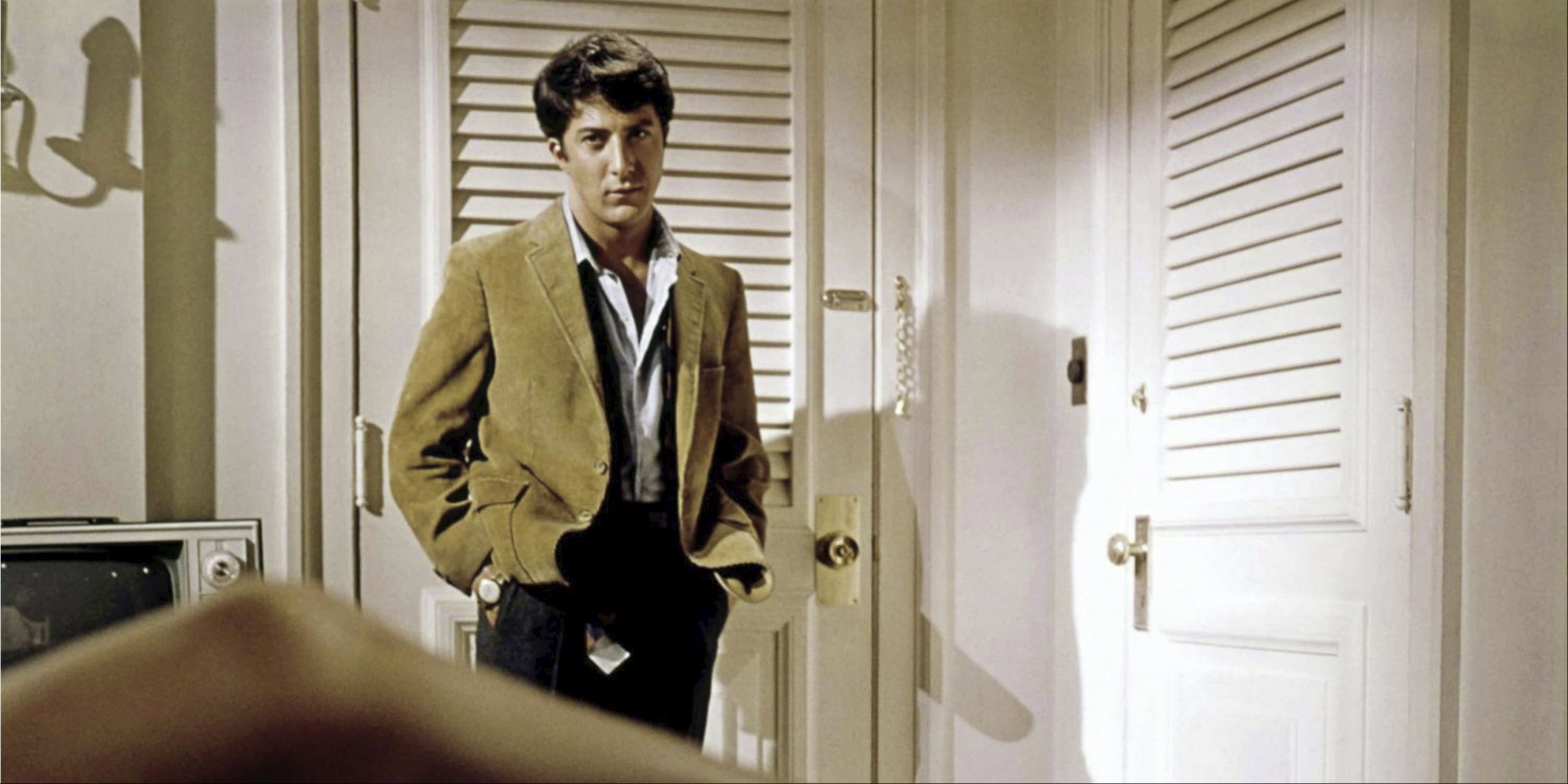
‘The Graduate’ (1967)
Anne Bancroft as Mrs. Robinson and Dustin Hoffman as Benjamin lie in bed together in The Graduate.Image via Embassy Pictures
“Mrs. Robinson, you’re trying to seduce me… aren’t you?” Another New Hollywood reference point, The Graduate perfectly captures the quiet panic of a young person with no clear direction. Benjamin Braddock (Dustin Hoffman in a breakout role), recently graduated from college, drifts through his life until he becomes entangled in an affair with Mrs. Robinson (Anne Bancroft), the wife of his father’s business partner. A big part of the film’s brilliance lies in its tone: it’s both comedic and deeply unsettling, using humor to highlight Benjamin’s confusion and isolation. Bancroft is iconic as Mrs. Robinson, but Hoffman’s performance is the more impressive one. His Benjamin is awkward, passive, insecure, and often frustrating, yet relatable. His nervous expressions, hesitant speech, and physical discomfort communicate more than pages of dialogue ever could. It’s why more than 50 years later, this movie still feels modern.
7
‘The Shawshank Redemption’ (1994)
Image via Columbia Pictures
“Get busy living, or get busy dying.” The Shawshank Redemption is one of cinema’s finest declarations of hope, as well as one of its most affecting portraits of male friendship. In it, Andy Dufresne (Tim Robbins) is wrongfully convicted of murder and sentenced to life in Shawshank prison, where he forms a bond with fellow inmate Red (Morgan Freeman) and gradually reshapes the world around him. From here, the movie pulls off a delicate balance between being life-affirming without feeling saccharine or contrived. It’s really about humanity’s potential to preserve dignity and purpose in even the bleakest circumstances. Instead of relying on constant twists or action, director Frank Darabont invests in character development and emotional accumulation. As a result, by the time major turning points arrive, they feel genuinely earned. The ending is among the most satisfying in film history.
6
‘Alien’ (1979)
Executive Officer Kane (John Hurt) after the alien took over his face in ‘Alien’ (1979).Image via 20th Century Studios
“In space, no one can hear you scream.” Ridley Scott’s haunted house movie in space begins with a simple idea, almost like something out of ’50s pulp sci-fi, but executes it with absolute control. The crew of the spacecraft Nostromo responds to a distress signal on a distant planet, only to bring a deadly organism aboard their ship. From there, Alien becomes a study in rising tension. The alien is rarely seen, its presence suggested through sound, shadow, and movement. The setting is realistic, industrial rather than super high-tech, and the characters behave in believable ways, making the unfolding horror feel much more visceral. And what horror it is. The Xenomorph is perhaps the most creatively designed monster in all of cinema, with its twisted life cycle, eyeless cranium, acid blood, barbed tail, mouth-bearing tongue, and relentless drive to kill, kill, kill.
5
‘There Will Be Blood’ (2007)
Smeared in oil, Daniel Plainview (Daniel Day-Lewis) sits watching his workers combat a blazing oil spout in ‘There Will Be Blood’ (2007).Image via Paramount Pictures
“I drink your milkshake!” Paul Thomas Anderson’s magnum opus is a towering portrait of obsession and isolation. Daniel Plainview (Daniel Day-Lewis), an oil prospector, builds an empire through ambition and ruthlessness, his drive gradually consuming everything around him. The story unfolds deliberately, allowing Plainview’s character to reveal itself over time. His relationships, particularly with his son (Russell Harvard) and with the preacher Eli Sunday (Paul Dano), become battlegrounds for control. PTA builds the tale into a sweeping American odyssey, touching on everything from capitalism and religion to the corrosive effects of power. At the eye of the storm is Day-Lewis’ performance, one of the best of the 21st century. He plays Plainview like a force of nature, an embodiment of wider impulses, yet without reducing him to a mere symbol or caricature. It’s phenomenal work that rightfully earned him an Oscar.
4
‘Goodfellas’ (1990)
Joe Pesci, Ray Liotta and Robert De Niro huddled together in GoodfellasImage via Warner Bros.
“As far back as I can remember, I always wanted to be a gangster.” The most vibrant of Scorsese’s gangster gems, Goodfellas immerses you in the frenetic lifestyle of Henry Hill (Ray Liotta) and his fellow gangsters. We follow him from his teenage years to his rise within the mob to his eventual downfall, getting a front-row seat to both the allure and the instability of that world. The structure and aesthetic perfectly mirror the subject matter, with rhythmic editing and scenes that move with kinetic energy. Thanks to Thelma Schoonmaker’s brilliant editing, Goodfellas moves through decades of history without ever feeling rushed or confusing. Then there are the killer needle drops and masterful camera moves, most famously the Copacabana tracking shot. The influence it had can’t be overstated. Countless crime movies and TV shows owe a debt to Goodfellas’ style, pacing, and characterization.
3
‘2001: A Space Odyssey’ (1968)
Image via Metro-Goldwyn-Mayer
“I’m sorry, Dave. I’m afraid I can’t do that.” Back in 1968, 2001: A Space Odyssey was a giant leap for cinematic sci-fi, breaking the ground upon which subsequent classics like Star Wars and Alien would be built. The movie is absurdly ambitious both in terms of its visuals and its narrative, from prehistoric Earth to deep space, delving deep into humanity’s evolution and its relationship with technology.
Dialogue is minimal, exposition nearly nonexistent; instead, we get stirring classical music, abstract shots that resist easy interpretation, and groundbreaking space imagery. Kubrick’s spacecraft move silently through space, obeying the laws of physics rather than the conventions of earlier sci-fi movies and operating on multiple levels. You can read 2001 as a warning about Promethean hubris, or as a statement on humanity’s search for meaning, or even as a spiritual journey.
Collider Exclusive · Sci-Fi Personality Quiz
Which Sci-Fi Hero Are You Most Like?
Paul Atreides · Captain Kirk · Princess Leia · Ellen Ripley · Max Rockatansky
Five iconic heroes. Five completely different ways of facing an impossible universe. One of them shares your instincts, your values, and your particular way of refusing to back down. Eight questions will tell you which one.
Paul Atreides
Capt. Kirk
Princess Leia
Ellen Ripley
Max Rockatansky
FIND YOUR HERO →
01
How do you lead when the stakes couldn’t be higher?
The way you lead under pressure is the most honest thing about you.
AI absorb everything — every variable, every pattern — and move only when I know the path forward.
BI read the room, make the call, and own the consequences. Hesitation costs more than mistakes.
CI rally people. A cause needs a voice, and I refuse to let fear be louder than conviction.
DI assess the threat, establish what needs doing, and get it done without waiting for permission.
EI don’t lead. I act. Others can follow or not — I’m already moving.
NEXT QUESTION →
02
What is your greatest strength in a crisis?
The quality that keeps you alive when everything else fails.
APrescience — the ability to see further ahead than anyone else and plan accordingly.
BImprovisation — I’m at my best when the plan falls apart and I have to invent a new one.
CConviction — I know what I’m fighting for, and that certainty doesn’t waver under fire.
DComposure — I stay functional when everyone around me is falling apart. Panic is a luxury.
EEndurance — I outlast things. I take the hit and keep moving long after others have stopped.
NEXT QUESTION →
03
What is the thing you’d sacrifice everything else for?
Your deepest motivation is your truest compass.
AThe survival and dignity of my people — even if I have to become something frightening to ensure it.
BThe safety of my crew — every single one of them. No one gets left behind.
CFreedom — for my people, for every world still crushed under the weight of an empire.
DThe truth — what actually happened, what’s actually out there, whether anyone believes me or not.
EThe one person — or the one memory — that still makes any of this worth surviving for.
NEXT QUESTION →
04
How do you relate to the people around you?
Who you are to others under pressure is who you really are.
AWith intensity and distance — I care deeply, but the weight I carry makes closeness complicated.
BWith warmth and irreverence — I take the mission seriously, not myself.
CWith directness and trust — I say what I mean, and I expect the people I work with to rise to it.
DWith professional care but clear limits — I’ll protect you, but I won’t pretend we’re family.
EWith wariness that slowly becomes loyalty — I don’t trust easily, but when I do, it holds.
NEXT QUESTION →
05
You’re facing a threat that no one else believes is real. What do you do?
How you respond when you’re the only one who sees it defines everything.
APrepare in silence. If they won’t listen, I’ll be ready when they finally have to.
BKeep pushing until someone listens — and if no one does, handle it myself.
CBuild the case, find the allies, and make the threat impossible to ignore.
DDocument everything. The truth matters even if no one believes it yet.
EStop trying to convince anyone. Survive it. That’s the only argument that counts.
NEXT QUESTION →
06
What has your heroism cost you personally?
Every hero pays. The question is what — and whether they’d pay it again.
AMy innocence — I’ve seen what I’m capable of, and I can’t unsee it.
BPeople I loved — the command chair has a view, but it’s a lonely one.
CA normal life — I gave up everything ordinary the moment I chose the cause.
DMy sense of safety — I know exactly what’s out there now, and I can’t pretend otherwise.
EAlmost everything — and I’m still not sure what I’m carrying it all for. But I keep going.
NEXT QUESTION →
07
How do you feel about the rules of the world you’re in?
Every hero has a relationship with the system. What’s yours?
AI understand them deeply — and I know exactly which ones must be broken, and why.
BI respect the spirit of them and bend the letter when the situation demands it.
CThe system is the problem. I’m not here to work within it — I’m here to dismantle it.
DI follow protocol until protocol stops being useful. Then I make the call myself.
EThe rules collapsed a long time ago. What’s left is instinct, and mine are reliable.
NEXT QUESTION →
08
When everything is on the line, what keeps you going?
The answer is the most honest thing about you.
ADestiny — or something that feels so much like it that the difference no longer matters.
BThe people on my ship — their faces, their trust, the fact that they’re counting on me.
CThe belief that what we’re fighting for is worth every sacrifice, including this one.
DSheer refusal to let it win — whatever it is. I don’t stop. That’s just who I am.
EI’m not sure anymore. But the road is still there, and I’m still on it.
REVEAL MY HERO →
Your Hero Has Been Identified
Your Sci-Fi Hero Is…
Your answers point to the iconic sci-fi hero who shares your instincts, your values, and your particular way of facing the impossible.
Arrakis · Dune
Paul Atreides
You carry a weight most people would crumble under — the knowledge of what you’re capable of, and the burden of what you might have to become.
You see further ahead than others and you plan accordingly, even when the vision frightens you.
You are driven by loyalty to your people and a sense of destiny you didn’t ask for but can’t escape.
Paul Atreides is not simply a hero — he is someone who understands the cost of power and chooses to bear it anyway.
That gravity, that willingness to carry what others won’t, is exactly you.
USS Enterprise · Star Trek
Captain Kirk
You lead with instinct, warmth, and an absolute refusal to accept a no-win scenario — because you’ve always believed there’s a third option nobody else has thought of yet.
You take the mission seriously without ever taking yourself too seriously.
Your crew would follow you anywhere, not because you demand it, but because you’ve earned it.
Kirk’s genius isn’t tactical — it’s human. He reads people, bends rules with purpose, and wills outcomes into existence through sheer conviction.
That combination of warmth, audacity, and relentless optimism is unmistakably yours.
The Rebellion · Star Wars
Princess Leia
You are the kind of person who holds the line when everyone else is losing faith — not because you’re fearless, but because giving up simply isn’t something you’re capable of.
You lead through conviction. Your voice carries because your belief is unshakeable.
You gave up everything ordinary the moment you chose the cause, and you’ve never looked back.
Leia is not a supporting character in her own story — she is the moral centre of the entire rebellion.
That same fierce, principled, unbreakable core is what defines you.
The Nostromo · Alien
Ellen Ripley
You are not reckless, not grandiose, and not particularly interested in being anyone’s hero — you just refuse to stop when it matters.
You see threats clearly, you document the truth even when no one listens, and when the time comes you handle it yourself.
Ripley’s heroism is earned, not performed. She doesn’t have a speech — she has a flamethrower and a plan.
You share her composure under the worst possible pressure, and her refusal to pretend the monster isn’t there.
When it counts, you don’t flinch. That’s everything.
The Wasteland · Mad Max
Max Rockatansky
You have been through fire that would break most people — and what came out the other side is something the world underestimates at its peril.
You don’t ask for help, don’t need validation, and don’t wait for anyone to tell you the rules no longer apply.
Your loyalty, when it finally arrives, is absolute — but it’s earned in silence and tested in action, not in words.
Max is not a nihilist. He is someone who lost everything and found, against his will, that he still has something worth protecting.
That bruised, stubborn, ultimately human core is exactly yours.
↻ RETAKE THE QUIZ
2
‘Pulp Fiction’ (1994)
John Travolta and Samuel L. Jackson as Vincent Vega and Jules Winnfield wearing black suits and holding a gun in ‘Pulp Fiction’Image via Miramax Films
“They call it a Royale with cheese.” Pulp Fiction arrived in the mid-’90s like a thunderbolt, immediately spawning copycats and opening up new possibilities for the medium. Tarantino’s time-twisting masterpiece tells multiple interconnected crime stories, shot through with violence, dark humor, fake Bible quotes, glowing briefcases, and countless pop culture references. It’s a postmodern crime epic, as well as a love letter to cinema itself. Not to mention, the screenplay is often considered one of the finest ever written. QT fills the film with conversations that have little to do with advancing the plot but everything to do with revealing character. Discussions about hamburgers, television pilots, foot massages, and obscure movies somehow become as compelling as robberies and shootouts. The dialogue feels natural and stylized at the same time, something countless filmmakers have tried (and typically failed) to replicate since.
1
‘The Godfather’ (1972)
Marlon Brando as Vito Corleone in The Godfather (1972)Image via Paramount Pictures
“I’m gonna make him an offer he can’t refuse.” The apotheosis of gangster cinema. 1972’s The Godfather tells the Shakespearean story of the Corleone crime family, centering on son Michael’s (Al Pacino) transformation from reluctant outsider to ruthless leader. Every scene builds on the last, every decision carrying weight. The performances are brilliant across the board, especially from Marlon Brando. His Vito is far and away the most iconic movie mobster. The script provides a sturdy foundation. The dialogue is memorable without feeling artificial, and nearly every scene advances either the plot or the characters. The screenplay treats organized crime not as a source of cheap thrills but as a lens through which to examine power and family dynamics. The result is a truly American epic, Coppola’s most well-rounded project, and perhaps the finest film of the last 6 decades.
تم النشر: 2026-06-17 04:26:00
مصدر: collider.com