
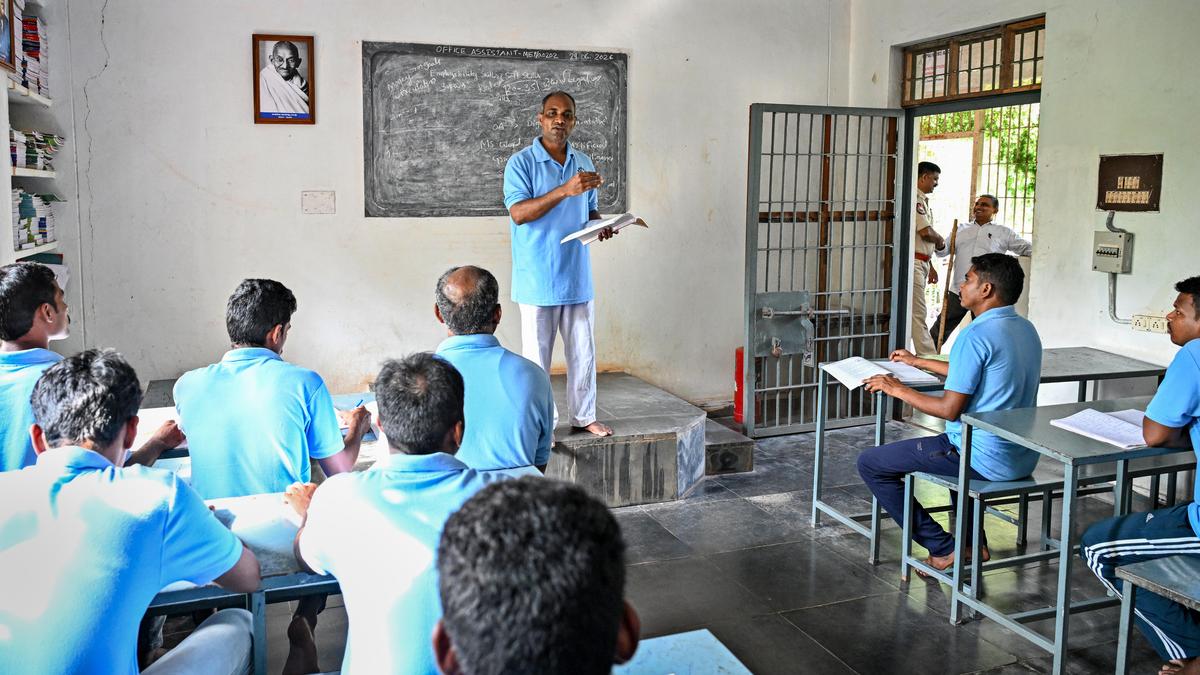
In Visakhapatnam Central Jail, learning skills for life away from crime
Young men in crisp blue uniforms file quietly into a book-lined classroom, each carrying a stack of textbooks. In a room adorned with motivational slogans about discipline, hard work, and success, they settle into neat rows, waiting for the day’s lesson to begin. Moments later, trainer D. Venkata Sai walks in with a book tucked under his arm. The class rises to greet him before settling in for a practical session on computer hardware and system troubleshooting. Questions come thick and fast, and the discussion soon expands to how artificial intelligence is reshaping the technological landscape.At first glance, the scene appears to be that of a college or a skill development centre. But in reality, it is actually inside the Visakhapatnam Central Jail, and the students are not ordinary learners but remand prisoners, with the trainer being a convict prisoner.As it turns out, the young remand prisoners are participating in an innovative rehabilitation initiative called the ‘Office Assistant’ programme, launched by the Visakhapatnam Central Jail authorities in collaboration with the Skill Development Institute (SDI). The programme is the brainchild of Central Jail Superintendent Mahesh Babu and Deputy Superintendent Ch. Surya Kumar, both of whom have professional backgrounds in Information Technology.It aims to equip young remand prisoners in the age group of 18 to 35 with basic computer knowledge and office management skills, enabling them to improve their employment prospects after their release. It primarily targets inmates charged under the Narcotic Drugs and Psychotropic Substances (NDPS) Act, who account for nearly 60 per cent of the prison’s inmate population.To guide these underqualified youth, the prison authorities looked inward, finding an instructor with an exceptional academic background—D. Venkata Sai. A native of Anakapalli district, Venkata Sai is a convict serving a sentence for abetment in a suicide case. He graduated from the Indian Institute of Technology (IIT) Madras and holds a Ph.D. in Chemical Engineering. Over the years, he has worked with prestigious organisations and now spends his time training young remand prisoners in digital and office skills inside the Visakhapatnam Central Jail.Looking ahead, Venkata Sai explains that the programme has been designed to begin with the fundamentals before gradually introducing advanced concepts. “We started with the basics, including the different components of a computer, storage devices, connected devices, printers, scanners, photocopiers and their purposes. Once the inmates became familiar with the hardware, we moved on to practical applications such as Microsoft Word, Excel, PowerPoint, cloud storage, data backup, routine office procedures and the maintenance of office equipment.”Hoping of helping them rebuild their lives, he says, “Besides technical skills, I am also training them in basic English communication, behavioural skills, and body language so that they become more confident while attending interviews and working in professional environments.”
Remand prisoners getting hands-on practice at the computer laboratory at Visakhapatnam Central Jail.
| Photo Credit:
K.R. DEEPAK
The programme is open to remand prisoners who have completed Class X, a qualification possessed by most of them. The first batch has already completed nearly a month of training and has another month remaining before the course concludes.According to Venkata Sai, the response has been overwhelming. “The students are extremely sincere. They attend every class with enthusiasm, ask questions, and are eager to learn. Many of them had never operated a computer before, but today they are comfortably using office applications and understanding concepts that are relevant in modern workplaces,” he says.Hopes and dreamsSuch positive outcomes align perfectly with the broader objectives of the jail authorities. Recognising that many of these inmates are at a critical stage in their lives, the jail administration believes that skill development can play a significant role in preventing them from returning to crime. By providing structured training in computer operations, office applications, and digital literacy, the authorities hope to prepare them for meaningful employment and successful reintegration into society.Driven by this vision, the jail authorities had established ‘Gnanasagar’ block, a dedicated education wing with the objective of transforming lives through learning. The block houses a well-equipped computer laboratory, a spacious classroom, and a large library stacked with books spanning various subjects, genres, and perspectives. It also serves as a learning centre for inmates preparing for open school examinations, Intermediate, and degree courses. Behind this academic block lies a peaceful garden where inmates spend time reading, reflecting, and preparing for examinations in a calm environment.For some, the change has been welcome. Among them is K. Sai Kalyan, 28, a remand prisoner booked under the NDPS Act, who recalls that a series of unfortunate decisions brought him here. “I never imagined my life would take such a drastic turn. I made mistakes without understanding the consequences. When this course was introduced, I saw it as an opportunity and decided that instead of spending my time doing nothing, I wanted to learn something useful. We are learning different computer applications and office software. I am putting in my best effort because once I am released, I want to secure a respectable job and begin a new life,” he says.Another 26-year-old remand prisoner, booked under the NDPS Act, who dropped out after Intermediate, expresses deep regret over the activities that landed him in prison. “I understand the pain my family is going through because of my mistakes. Every day here reminds me of how one wrong decision changed the entire course of my life. This programme has given me hope that I can rebuild my life. I want to complete this course, find a decent job after my release, and support my parents and family. I don’t want them to suffer because of my actions,” he shares on an emotional note.ChallengesSuch remand prisoners’ background reflects a broader regional challenge that prison authorities are trying to tackle at its roots. Until a few years ago, parts of the Alluri Sitharama Raju (ASR) district and the Andhra-Odisha Border (AOB) region were known for illegal ganja cultivation. Although stringent enforcement measures and the formation of the Elite Anti-Narcotics Group for Law Enforcement (Eagle) have drastically reduced cultivation in Andhra Pradesh, the crop continues to be grown in certain parts of neighboring Odisha.The contraband is often transported through transit routes passing across ASR, Anakapalli, and Visakhapatnam districts. In the process, several unemployed youngsters from Anakapalli, ASR, Vizianagaram and nearby regions are lured into the illegal trade with promises of quick money, expensive mobile phones, and easy earnings. Many are recruited merely as pilots or escorts for smuggling vehicles without fully understanding the legal consequences. By the time they realise the seriousness of the offences, they often find themselves facing cases under the Narcotic Drugs and Psychotropic Substances (NDPS) Act.Prison officials believe initiatives such as the ‘Office Assistant’ programme can help prevent such youngsters from returning to crime.
An outside view of the Visakhapatnam Central Jail.
| Photo Credit:
K.R. DEEPAK
For over a decade, the Visakhapatnam Central Jail has focused on skill development and rehabilitation by equipping inmates with vocational training aimed at improving their employability and helping them reintegrate into society after their release. In association with the Skill Development Institute (SDI), the prison has conducted a range of training programmes in trades such as plumbing, welding, carpentry, tailoring and jute bag manufacturing.Building on this legacy, the prison has now introduced the ‘Office Assistant’ training programme, a first-of-its-kind initiative in the Andhra Pradesh prison system.For K. Gowri Naidu from Vizianagaram, who has been in judicial remand for the past three months in connection with a family dispute case, the programme has opened up new possibilities. “I have been attending these classes for the past month and have learned many useful skills. This is a wonderful opportunity for people like us. If everything goes well after my release, I want to start an internet centre and earn my livelihood honestly,” he says.To deliver on this promise, the programme follows a rigorous daily routine. Every day, Venkata Sai conducts one-and-a-half hours of classroom teaching, followed by another one-and-a-half hours of practical training in the computer laboratory. During the practical sessions, inmates receive hands-on experience in operating computers, preparing documents, creating presentations, and handling office software under the trainer’s close supervision.This programme is inspired by the State government’s emphasis on digital transformation and the rapid expansion of the IT sector across North Andhra, particularly in Visakhapatnam. Conceptualised by Central Jail Superintendent Mahesh Babu and Deputy Superintendent Ch. Surya Kumar, the initiative seeks to prepare inmates for employment opportunities in the modern digital economy.Tech-driven futureOutlining the initiative’s goals, Deputy Superintendent Ch. Surya Kumar says, “Visakhapatnam Central Jail has always encouraged inmates to learn skills. This time, we wanted to introduce a programme that matches today’s employment landscape and supports the government’s vision of creating a technology-driven workforce. If these youngsters acquire digital skills and secure jobs after their release, it will transform their lives and significantly reduce the chances of them returning to crime.”He says currently the jail houses around 1,600 inmates, including nearly 350 convicted prisoners, while the remaining are remand prisoners. According to him, nearly 60 per cent of the inmates have been booked under the NDPS Act. A majority of them belong to the age group 18 to 35, with many hailing from tribal communities, the Andhra-Odisha Border (AOB) region and neighbouring districts. Several of these youngsters become involved in drug-related offences without fully understanding the long-term consequences of their actions, he adds.The ‘Office Assistant’ programme is being implemented in collaboration with the Skill Development Institute, which has provided study materials, books and training content. Upon successful completion of the programme, participants will receive certificates issued by the SDI. Importantly, the certificates will not indicate that the course was completed inside a prison, thereby ensuring that the beneficiaries are not subjected to stigma while seeking employment.Mr. Surya Kumar says the prison administration is also working closely with the Skill Development Institute to facilitate employment opportunities for trained inmates after their release. Since the SDI regularly organises job melas across different locations, the jail authorities are exploring ways to ensure that eligible candidates are given an opportunity to participate in these recruitment drives. “We are coordinating with the Skill Development Institute so that these youngsters can attend job melas after completing the course. Our hope is that they secure meaningful employment and begin a new chapter in their lives with dignity and self-reliance,” he says.This digital training builds upon a long-standing culture of rehabilitation within the facility. Over the years, the jail authorities have partnered with various organisations to help inmates learn diverse skills, such as manufacturing furniture, blankets, garments, and jute products.Even during the COVID-19 pandemic, the prison earned widespread appreciation for manufacturing face masks. Today, in addition to these vocational activities, inmates operate a popular bakery and cultivate vegetables using organic farming methods. All of these inmate-made products—including the bakery items, fresh vegetables, and homemade food—are sold through a dedicated store outside the prison premises, which has become popular among residents of the surrounding areas.By bridging the gap between historical rehabilitation and the modern digital economy, the Visakhapatnam Central Jail is providing these young remand prisoners with a new start toward a crime-free future.
تم النشر: 2026-07-03 04:13:00
مصدر: www.thehindu.com