Lobga Rangzen, the Tibetan Activist Who Set Himself on Fire in Manhattan
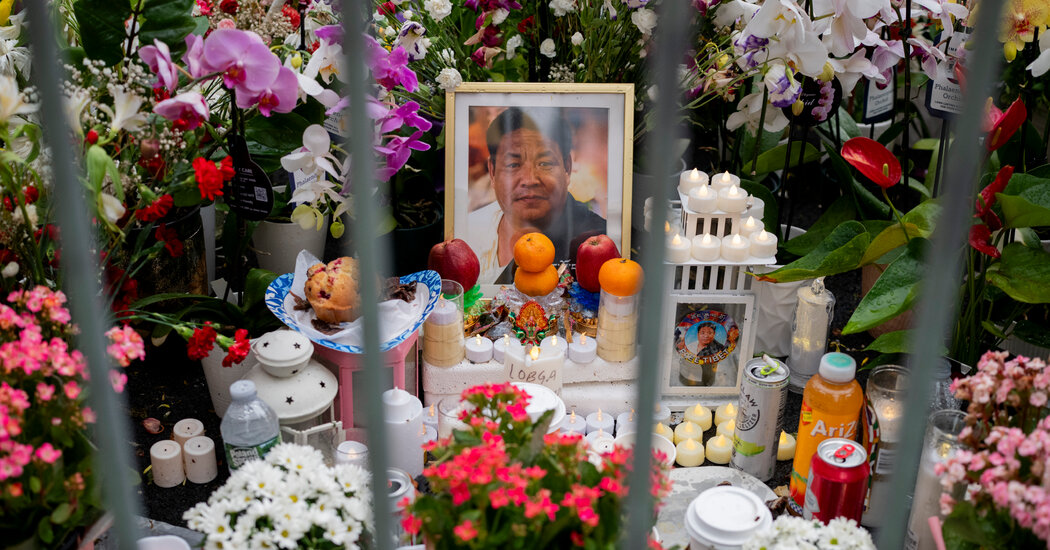
It was 91 degrees in Manhattan and even hotter on the pavement, but the Tibetans gathered as planned outside the Chinese Consulate. Amid the waving flags and synchronized chants, one of the protesters, Ngawang Tashi, looked for his friend Lobga Rangzen.Lobga Rangzen was a stalwart of events like this. His friends joked that he was happier at protests than on his birthday. At protests, he felt most useful to the cause of Tibetan independence from China — a cause to which he was so devoted, he had even put it in his name: Rangzen means “independence” in Tibetan.Ngawang Tashi scanned the crowd once, then again. It was strange that Lobga Rangzen wasn’t there.The next evening, July 2, he was at Costco when another friend called.“Come to the United Nations right now,” the friend said. “He is in front of there and burning.”Around the world, many people had already seen what Ngawang Tashi was just learning: Lobga Rangzen, 52, had set himself on fire in front of the United Nations headquarters in Manhattan, streaming the act live on Facebook. He had planted a Tibetan flag on the pavement and taken out fliers that demanded FREE TIBET and CHINA OUT OF TIBET. Then he lit his chuba, or Tibetan robe, on fire.Ngawang Tashi couldn’t make sense of the news. He had just seen Lobga Rangzen a few days earlier, at their weekly Tibetan dance group. Hadn’t Lobga Rangzen just promised to make his famous Tibetan sausages for a party a few days later? Surely, he reassured himself, his friend would be fine.But when he arrived at the hospital where firefighters had taken Lobga Rangzen, a nurse told him that he was too late. He could go in just to pay his last respects.Since then, Ngawang Tashi has been grieving. But as politicians, including Mayor Zohran Mamdani and Representative Alexandria Ocasio-Cortez, issued statements of mourning and major media outlets wrote about his friend’s death, he, and many Tibetan activists, have also struggled with a grim realization. Lobga Rangzen’s unthinkable act — the first known self-immolation by a Tibetan in the United States — may have achieved one of his greatest goals, however briefly: He made the world pay attention to Tibet.“The other activities we Tibetans were doing, nobody is going to care about that,” Ngawang Tashi said. “Now everybody is talking.”A week after Lobga Rangzen’s death, Ngawang Tashi sat inside his friend’s bedroom on the third floor of a narrow house in Queens. The two had shared the place for several years. Beside Ngawang Tashi was Lobga Rangzen’s niece, Sonam Choedon, who had lived there for several months after moving to the United States from India last year.All around them were reminders of the time they had spent with Lobga Rangzen, and how closely it had been intertwined with protest. On the dresser was a snapshot of Lobga Rangzen with friends, including Ngawang Tashi, during a 13-day walk they made from New York to Washington in 2014 for Tibetan rights. On a table, there was a framed photograph of Sonam waving a Tibetan flag at a protest her uncle had taken her to last summer.A tangle of plastic badges hung from the curtain rod, showcasing volunteer stints over the years: as a security guard when the Dalai Lama, Tibet’s exiled spiritual leader, visited New York; as a videographer for an advocacy event. Awards from Tibetan activism groups covered the walls. A brightly colored tapestry of the Potala Palace, the former residence of the Dalai Lamas, was pinned over his bed. The only non-Tibetan element was a vibrating exercise machine, with a few shirts neatly draped over the arms.“I used to dance with him in this room,” Ngawang Tashi said, gesturing to the narrow strip of floor between the table and the bed, where they had followed along with Tibetan music videos.Sonam smiled. Sometimes, when her uncle walked toward his friends on the street, she said, “you could see him come dancing.”Lobga Rangzen’s room was a shrine to a homeland he hadn’t seen in more than 30 years. He was born in a remote part of eastern Tibet, as Lobsang Palden. (Tibetans usually do not have family names, only given names.) China had occupied Tibet since the 1950s, and he grew up hearing about how his family had resisted that occupation, Sonam said. Three of his uncles fought the Chinese Army in the 1950s, with one killed in combat and another dying in prison.As a child, Lobga Rangzen was sent to a monastery for education. But the Chinese government allowed only one monk per family, and a relative had already taken his vows.So in 1992, when he was 18, he and an uncle fled. The journey to escape Tibet is treacherous, often involving weeks of trekking through the Himalayas at night to avoid detection by Chinese guards. Lobga Rangzen’s parents and three siblings, unable to make the journey, stayed behind. But Lobga Rangzen and his uncle made it to a refugee center in Nepal run by the Tibetan government-in-exile.From there, Lobga Rangzen was sent to a monastery in southern India, where he rallied other monks to attend protests against China.In 2006, he arrived in the United States. Sonam wasn’t sure why he left India, but said that monasteries often sent members overseas to share their beliefs. In New York, Lobga Rangzen received asylum. He eventually left the monkhood, and threw himself into activism.At the time, Tibet was drawing global attention. Ahead of the 2008 Olympics in Beijing, monks and nuns in Tibet led mass protests against Chinese rule. The Chinese government responded violently, with rights groups saying that possibly hundreds of people died. (The Chinese government said the death toll was 22.)Leaders worldwide expressed outrage. President George W. Bush called for China to hold talks with the Dalai Lama.In New York, Lobga Rangzen was eager to contribute to the momentum. He built floats for regular protests outside the Chinese Consulate and staged hunger strikes near the United Nations. He shared photos of himself on social media meeting with politicians — Democrats and Republicans — at the Capitol.Initially, he had worked in construction, but his bosses wouldn’t let him take time off for protests. He turned to driving for Uber instead. He never married, which, his friends said, didn’t bother him. He could devote himself completely to the cause.Lobga Rangzen, who drove for Uber, sometimes spoke about Tibet to his passengers. “Today I ran into the famous American actor and filmmaker Forest Whitaker,” he wrote in the caption to a photo he posted online last year. “He also discussed Tibetan issues.”But he did occasionally acknowledge the pain of one sacrifice: Ten years ago, he cut off direct contact with his family in Tibet, fearing that his work would jeopardize their safety. He communicated with them only through a cousin in the United States, Lobsang Samdup.Samdup said he had asked Lobga Rangzen to reconsider, telling him it was OK to think about himself more. “He said, ‘That’s not even a question,’” Samdup recalled.For all his fervor, though, Lobga Rangzen was a cheerful figure. He always sat in the front row for performances by a stand-up comedian friend, though he knew he’d be picked for punchlines. He enjoyed hiking in upstate New York, singing as he trekked.After late-night Uber shifts, he would meet up around 3 a.m. with other Tibetan driver friends at Indian restaurants in Midtown Manhattan, regaling them with gossip or folk tales.“Sometimes I’d joke with him, ‘Hey, are those stories real?’” said one of those friends, Dechen Sangpo. “He would be like, ‘Doesn’t matter, you guys like it, right?’”In recent months he was often found at the High Asia Research Center, a basement library in Queens set up by a Tibetan writer, Jamyang Norbu. Lobga Rangzen had salvaged old bookshelves from the street to help fill it.He’d been especially enthusiastic about a pamphlet that Jamyang Norbu had written about Tibet’s history as an independent state. What if, Lobga Rangzen suggested, he turned the pamphlet into a slide show and drove cross-country with it playing on a screen atop his car? “He has ideas all the time,” Jamyang Norbu said. Even if some didn’t pan out, he said, “at least someone is making the effort to work things out.”The first person to self-immolate in Tibet to protest Chinese rule was a 24-year-old monk, in 2009.That spring, when the government forbade memorials to the victims of the previous year’s protests, the monk, Tapey, set himself on fire.Over the next decade, more than 150 other Tibetans would do the same, with 28 in November 2012 alone, according to the Tibetan exile government.Self-immolation is, for many people, perhaps the most unfathomable of political protests. When people have chosen it as their final act — whether they were Tibetans, or Vietnamese monks protesting religious suppression in the 1960s, or more recently, American activists drawing attention to climate change or the war in Gaza — the public response has been not only horror and sympathy, but also bewilderment. Scholars have said self-immolation can become a last resort when no other form of protest is available, at least in Tibet. (Nearly all the Tibetan self-immolations have occurred inside Tibet, with a few in India or Nepal.) “If Tibetans saw even a sliver of an opportunity to hold demonstrations, then they would not resort to self-immolation,” Tsering Woeser, a leading Tibetan poet and scholar, has written.In New York, Lobga Rangzen protested all the time, to little apparent effect. As China’s economy grew, other countries became more reluctant to challenge it on human rights issues. Even some fellow Tibetans seemed to be resigned to Chinese rule.The repression in Tibet, though, was unrelenting. Earlier this year, China announced that it would enact a new law to promote “ethnic unity.” The law mandates the use of Mandarin Chinese as the language of instruction in schools, and says that the Chinese government would pursue people who create “ethnic division” — the government’s label for political activism by ethnic minorities — even overseas.Lobga Rangzen spent hours each week at the Tibetan library, talking to Jamyang Norbu about the need for new tactics. Jamyang Norbu sensed that the cross-country drive idea wasn’t satisfying him.“But you know, other than that, what can you do now? This is the problem he faced in life. We don’t have resources,” he said. “He was running out of ideas.”Lobga Rangzen did not raise the idea of self-immolation to his niece, cousin or any of his friends. Only Ngawang Tashi said that he once talked about it — more than 10 years ago. During the peak of the immolations in Tibet, Lobga Rangzen had asked him for advice on writing a last statement. Ngawang Tashi told him he was more useful alive. Lobga Rangzen never mentioned it again.But in recent months the new law had weighed heavily on him. He called one friend to say the Chinese government was trying to cut out Tibetans’ tongues. He told another that Tibetans overseas might not be safe, either.On June 30, the day before the law went into effect, he called Dechen, his friend who had also driven Ubers. Dechen had recently finished law school, and Lobga Rangzen congratulated him. But, he said, Dechen should remember not to focus only on money. “I want you to contribute for Tibetan independence,” he told him.Dechen was surprised. Lobga Rangzen rarely offered him unsolicited advice. “I was like, ‘OK, why are you telling me this?’” Dechen said. “He was like, ‘It just came to mind, so I just wanted to share with you.’”The next day, he called again, to say hello from a hike upstate, where he’d gone with his niece and several friends. It was July 1, the day of the demonstration against the new law at the Chinese Consulate. Lobga Rangzen didn’t mention the protest.On July 2, he called for a third straight day. Dechen suggested grabbing lunch together, but Lobga Rangzen said it was too hot. Besides, he said, he had to take care of some things.“Call me back when you’re done,” Dechen said. “Let’s meet.”“All right,” Lobga Rangzen said.Four hours later, Lobga Rangzen sat down, cross-legged, under metal scaffolding across from the United Nations building. For six minutes, he spoke into his phone camera, denouncing what he called China’s efforts at “completely erasing Tibet’s existence” and asking Tibetans in exile to unite. He spoke calmly, even as sweat beaded on his forehead from the sweltering heat.“If I do a big action today, I want you to know it is not for any personal reason. It is not because I have nothing to eat or nothing to wear, but because I am doing this for my country,” he said.“I don’t want you to mourn for me. I want you to continue the struggle for Tibetan independence.”Moments later, a 911 caller reported a man on fire.In retrospect, Lobga Rangzen’s friends realized there may have been signs. He and Dechen usually spoke a few times a month, not three days in a row. At his last dance group meeting, he had given a shirt to Ngawang Tashi, insisting he take it even when Ngawang Tashi said he had plenty.No one could pinpoint when Lobga Rangzen had started planning but they were sure that his decision had not been spontaneous, but strategic. At the heart of activism, he knew, was the competition for attention. He had just been waiting for the moment when he thought he could have impact.Some of his friends quietly acknowledge that his action might not make a difference with the U.S. government or the United Nations. Still, their responsibility is to try to make sure it does.In the weeks since Lobga Rangzen’s death, hundreds of people have turned out for a stream of events in his honor. There was a 6 a.m. prayer service, a march to the Chinese Consulate and near-daily gatherings at the United Nations. Even his funeral became a protest, with attendees wearing Free Tibet baseball caps and T-shirts. On the Wednesday after his death, about a dozen members of his dance group, including Ngawang Tashi, gathered after sunset in front of the United Nations. Metal barriers guarded the site of the immolation, where heaps of flowers and multicolored Tibetan prayer flags surrounded a photo of their friend, smiling serenely.The group sat down on the pavement in front of the makeshift altar, heads bowed, and made a promise. In his last message, Lobga Rangzen had urged Tibetans to keep dancing, to preserve their culture. But they were too sad to dance now, Ngawang Tashi said. So for 49 days — in Tibetan Buddhism, the time it takes for the soul to be reborn — they would not, though they would carry out his wishes in other ways, including protesting.Then, “after that,” Ngawang Tashi said, “we will keep on dancing, as you advised.”
تم النشر: 2026-08-05 18:11:00
مصدر: www.nytimes.com