To Sell Homer’s ‘Odyssey,’ Book Publishers Get Creative
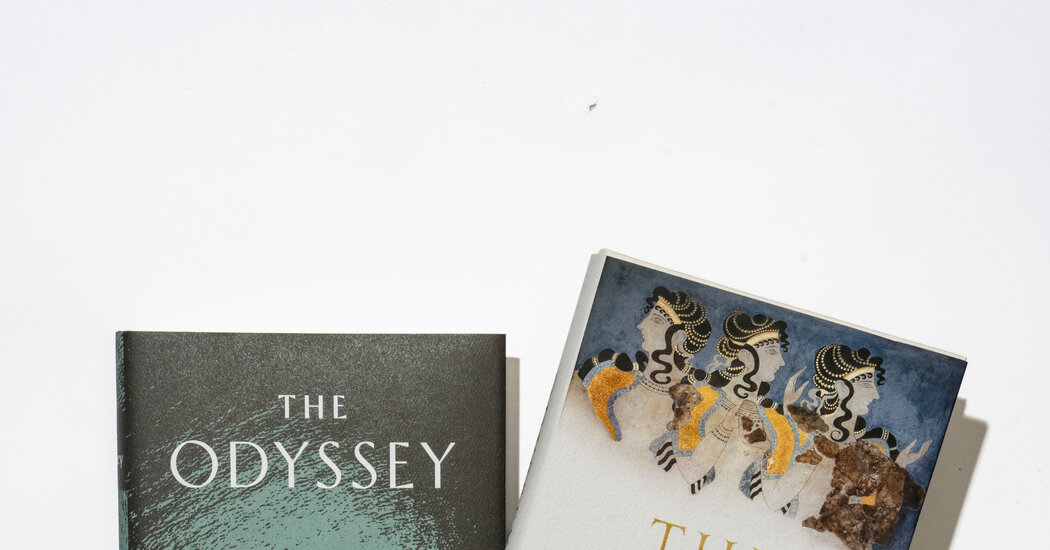
It’s the climax of the “Odyssey.” Odysseus, back in Ithaca at long last, finds his home swarming with suitors vying for the hand of his wife, Penelope, and for his throne. He needs to overthrow the interlopers and reclaim his rightful place. The question is: How?In their own way, book publishers are fighting a similar battle.Public interest in the “Odyssey” surged in the lead-up to the release of the director Christopher Nolan’s star-studded adaptation of Homer’s epic last week. So far this year, sales of the “Odyssey” rose by 76 percent compared with last year, according to Circana BookScan, a book industry sales tracker.For the publishers putting out any of the dozens of translations of the “Odyssey” currently available, that presents both a challenge and an opportunity. Here’s how a few of them are meeting the moment.Freshen it upThe most direct way publishers are elevating their translations of the “Odyssey” is by giving them splashy reissues.Picador is one such publisher. In May, the imprint, which in the United States is a branch of Farrar, Straus & Giroux, released a new edition of Robert Fitzgerald’s 1961 translation of the “Odyssey.” Nolan’s film directly influenced its rerelease strategy.“We originally planned to publish our deluxe reissue of the ‘Odyssey’ in fall 2025, but moved it to spring 2026 so we could take advantage of the excitement surrounding Christopher Nolan’s film adaptation,” Sheila O’Shea, the director of publicity and marketing at Farrar, Straus & Giroux and Picador, said in an email. In addition to calibrating the timing, Picador gave the reissue a glitzy new look, with a vibrant green cover, foil stamping, French flaps and deckled edges.Picador is not alone in applying a fresh coat of paint to the epic. In June, Penguin Classics reissued Robert Fagles’s 1996 translation in a hardcover wrapped in a colorful jacket featuring figures from the poem.The release date for Nolan’s movie was serendipitous for Penguin Classics, where plans were already underway to mark both the 30th anniversary of Fagles’s translation and the 80th anniversary of the imprint itself, which launched in 1946 with E.V. Rieu’s translation of the “Odyssey.”“It was beautiful timing, actually,” Elda Rotor, publisher of Penguin Classics, said in a statement. “As filmgoers anticipated his cinematic interpretation of Homer’s epic, at the same time we were preparing to celebrate the Fagles translation.”Star powerInstead of reissues, some imprints are harnessing another tool: celebrity.Although many of the most popular translations of the “Odyssey” are decades old, two recent translations have gained cultural prominence. In 2017, W.W. Norton & Co. published a translation by the University of Pennsylvania professor Emily Wilson. And last year, the University of Chicago Press released a version translated by the Bard College professor Daniel Mendelsohn.Classicists are stereotyped as monkish, spending their time cloistered in the ivory tower of academia, but both Wilson and Mendelsohn are surprisingly buzzy media figures. Mendelsohn’s cultural criticism is as acclaimed as his scholarship, and he has written for publications including The New York Times, The New Yorker and The New York Review of Books.Wilson, who is the first woman to translate the “Odyssey” into English, became a lightning rod for two reasons. First, her provocatively blunt translation ignited a fierce debate about the best way to translate Homer. Second, her work got swept up in the culture wars, as she put it in a recent interview with New York magazine.“After I published the ‘Odyssey’ translation, it was both celebrated in quite simplistic ways as a work of girl power,” Wilson told New York last month. “It also faced backlash.”The fact that both translators have garnered a reliable amount of name recognition has, in this moment of “Odyssey” fever, been a boon.“It may come as no surprise that we are, indeed, promoting Emily Wilson’s translation, but what is more surprising is how much interest is bubbling up spontaneously,” Norton’s chief communications officer, Louise Brockett, said in an email. “There have been Emily Wilson read-alongs; there have been ‘Odyssey’ book clubs.”Like Wilson, Mendelsohn “has already been a go-to voice for reporters covering the movie who want to know more about the poem and about Homer’s world,” Levi Stahl, the marketing director for the University of Chicago Press, said in an email.In the lead-up to the movie’s release, Mendelsohn published pieces about the “Odyssey” in The Times and The Free Press, and on Friday, he reviewed the movie for The New York Review of Books. To further connect Mendelsohn’s name with the phenomenon, Stahl added, “we’ve been drawing the connection with our social media and direct-to-consumer outreach since the first trailer.”Emphasize differencesHomer’s verse is considered particularly tricky to translate, and there’s no definitive method for bringing his poems into modern English.“It is very difficult to capture the tone of the poems, which is elevated (clearly very different from everyday speech), yet can be colloquial and emotional at times and is always vivid and immediate,” Egbert Bakker, a professor of Greek language and literature at Yale, said in an email. “The ‘Odyssey’ is one of these works of verbal art that transcends translation.”Each translator takes a different tack. Picador highlights the lyrical flair of Fitzgerald’s translation, which “continues to stand apart because it combines deep scholarship with the instincts of a practicing poet,” O’Shea said.Norton stresses the briskness of Wilson’s version. “It feels like the ancient Greek: direct, accessible and compelling,” Brockett said. “Wilson’s is one of the first metrical translations in recent memory, offering the English-language reader or listener the same sense of motion and adventure, in iambic pentameter, that the original listener to this epic poem would have perceived in their era, in their meter.”At the University of Chicago Press, the team is emphasizing Mendelsohn’s fidelity. “Our translation is the most poetic, accurate and faithful to the original, as Daniel Mendelsohn deliberately replicated Homer’s long lines and attended carefully to the poem’s metaphors, tone, level of diction and word choice,” Stahl said.And Penguin Classics is leaning on its legacy as a classroom staple. “Fagles’s translation remains one of the most widely taught editions of the ‘Odyssey’ in U.S. higher education, continuing to be assigned by hundreds of instructors and reaching thousands of students each year,” Rotor said.Moviegoers who are just now giving Homer a go might feel overwhelmed by the glut of translations of the “Odyssey” to choose from. But keep in mind, as David Elmer, a professor of Greek literature at Harvard, puts it: “No translation is perfect, and everyone has their own taste.”
تم النشر: 2026-07-20 17:32:00
مصدر: www.nytimes.com